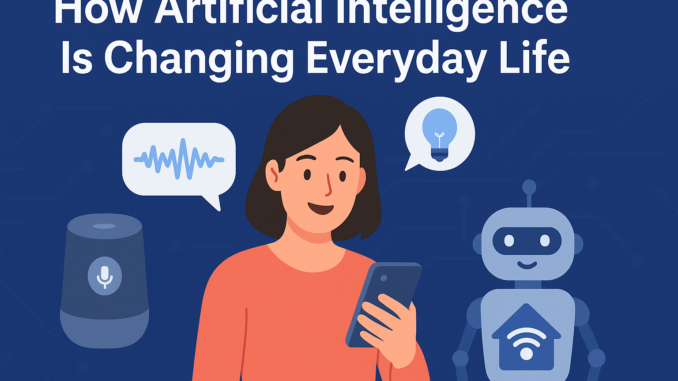
How Artificial Intelligence Is Changing Everyday Life: Trends You Should Know
Artificial Intelligence (AI) has grown from a futuristic concept into one of the most influential technologies shaping the modern world. It is no longer limited to robots, research labs, or tech giants. Today, AI touches almost every part of daily life—often in ways people do not even realize. From smartphones and smart home devices to transportation, healthcare, education, finance, and entertainment, AI is transforming how we live, work, and interact.
This article explores how AI is changing everyday life and highlights the top trends you should know in 2025 and beyond.
AI in Everyday Life: An Invisible Assistant
For many people, AI is quietly working in the background. When you unlock your phone with your face, ask a digital assistant to play music, or get movie suggestions on a streaming platform—you are using AI. Its integration is so seamless that most users don’t even notice it.
AI now analyzes patterns, predicts needs, optimizes tasks, and makes decisions. It is designed to understand human behavior and adapt to individual preferences. As a result, daily routines are becoming faster, easier, and more personalized.
1. Smarter Smartphones and Personal Assistants
Smartphones are the most accessible example of AI in daily life. The latest mobile devices feature AI-powered cameras, voice assistants, real-time translation, and security enhancements.
Examples of AI on Smartphones
- Face and fingerprint recognition for security
- Camera processing that improves lighting, sharpness, and color
- Voice assistants like Siri, Google Assistant, and Alexa
- Predictive text and autocorrect
- Spam call and message filtering
Digital assistants have become more conversational and capable of understanding complex commands. They can remind you of appointments, control home devices, provide traffic updates, and even hold natural-sounding conversations. In 2025, these assistants are becoming more context-aware, meaning they understand not only what you say but also what you mean.
2. AI-Powered Smart Homes
Smart homes are becoming more common as devices like smart speakers, thermostats, lights, and security systems become affordable and easy to set up.
What AI Does in Smart Homes
- Adjusts lighting based on time of day
- Learns preferred room temperature
- Detects unusual activity for home security
- Controls appliances through voice commands
- Saves energy by optimizing usage patterns
In 2025, AI-driven home automation systems can predict household needs. For example, your home can detect when you wake up, start brewing coffee, open the curtains, and adjust the room temperature—all without you touching a button.
3. AI in Healthcare: Personalized and Efficient Care
Healthcare is one of the most transformative areas affected by AI. With advanced tools and medical data processing, AI improves accuracy, speeds up diagnosis, and personalizes treatment.
Major AI Applications in Healthcare
- AI-assisted diagnosis using medical imaging
- Predictive analytics to detect diseases early
- Wearable health monitoring devices
- Robotic surgeries with improved precision
- Personalized treatment plans based on genetic data
Wearables like smartwatches now track heart rate, blood oxygen, sleep patterns, and more. These devices use AI to analyze data and alert users to potential health concerns. This early detection can save lives.
In 2025, AI continues to strengthen telemedicine, allowing patients to consult doctors remotely with accurate diagnostic support.
4. AI in Education: Smarter Learning Experiences
Education has been completely reshaped by AI-driven tools, especially after the global shift toward digital learning.
How AI Enhances Education
- Personalized learning based on student strengths and weaknesses
- AI tutors that explain concepts in simple terms
- Automated grading and feedback
- Learning apps that track progress
- Virtual classrooms with interactive AI tools
Students can learn at their own pace, and teachers can spend more time focusing on individual needs rather than manual administrative work. AI-powered language learning apps—like Duolingo and other platforms—are becoming smarter and more adaptive, recognizing where learners struggle and adjusting lessons accordingly.
5. AI in Transportation: Safer and Smarter Travel
AI plays a major role in modern transportation systems, from navigation apps to autonomous vehicles.
AI in Daily Travel
- Real-time traffic prediction
- Route optimization
- Driver-assistance systems
- Ride-sharing algorithms
- Autonomous delivery robots and drones
Navigation apps like Google Maps use AI to predict traffic, suggest quicker routes, and estimate travel time. Meanwhile, advanced driver-assistance features—such as lane detection, automatic emergency braking, and adaptive cruise control—help prevent accidents.
Autonomous vehicles are steadily improving in 2025, with safer sensor systems and AI-powered decision-making.
6. AI in Entertainment and Social Media
Entertainment is now highly personalized thanks to AI.
How AI Shapes Entertainment
- Movie and music recommendations
- Personalized social media feeds
- AI-generated content and visuals
- Real-time game optimization in gaming
- Smart photo and video editing tools
Platforms like Netflix, YouTube, and Spotify analyze viewing habits to suggest content that matches your preferences. AI-powered editing apps can enhance photos automatically, remove noise, and even generate creative styles.
AI-generated music, art, and writing tools are becoming mainstream. These technologies help creators explore new ideas faster and enhance their work.
7. AI in E-Commerce and Shopping
The way people shop has changed dramatically with AI.
AI Improves Shopping By
- Personalized product recommendations
- Smart chatbots for customer service
- Voice shopping through digital assistants
- Automated checkout systems
- Visual search—find items by uploading photos
Retailers use AI to analyze shopping behavior and offer personalized deals. Chatbots provide instant customer support, answer questions, and help track orders. Some stores now use cashier-less AI systems that automatically detect products and charge customers without waiting in line.
8. AI in Workplaces: Boosting Productivity
AI helps businesses operate more efficiently by automating repetitive tasks and analyzing data.
AI in Professional Life
- Automated scheduling and email management
- Document analysis and data extraction
- AI-powered project management tools
- Smart hiring and resume screening
- Enhanced cybersecurity systems
AI agents—advanced digital workers—can now perform multi-step tasks like data entry, research, reporting, content drafting, and more. This frees up employees to focus on creative or strategic work.
9. AI in Finance: Smarter Decisions and Higher Security
AI is transforming how people manage money, invest, and stay protected from fraud.
Financial AI Use Cases
- Fraud detection and prevention
- AI-powered investment advisors
- Personalized budgeting apps
- Credit scoring based on behavior
- Automated bill payments and reminders
Banks use AI to monitor suspicious account activity instantly. Robo-advisors create investment portfolios based on personal goals and risk levels. Budgeting apps track expenses and provide financial insights.
10. AI in Communication and Language
AI has rewritten how we communicate globally.
AI Enhances Communication By
- Real-time translation
- Predictive text suggestions
- Smart email filtering
- Voice-to-text and text-to-voice conversion
- AI writing assistants for clarity and tone
Language barriers are shrinking thanks to AI-powered translation tools. People can communicate across cultures with ease, helping businesses and individuals collaborate seamlessly.
AI Trends You Should Know in 2025
As AI continues to advance, several trends are shaping the future:
1. AI Agents as Digital Workers
AI is moving beyond assistance to taking action. AI agents can complete tasks, analyze information, and interact with software independently.
2. Hyper-Personalization
From shopping to entertainment, AI customizes everything to match user preferences.
3. Improved AI Safety and Transparency
Companies are building AI systems that are more ethical, controlled, and transparent.
4. AI Integration with 6G and IoT
Faster networks and more connected devices make AI smarter and more responsive.
5. AI for Sustainability
AI supports clean energy, waste reduction, smart agriculture, and climate modeling.
The Future of Everyday Life With AI
As AI becomes even more integrated, daily routines will continue to evolve. Homes will run more intelligently, healthcare will become more proactive, education will become more personalized, and businesses will operate more efficiently.
Instead of replacing people, AI aims to empower them—helping humans make better decisions, save time, and improve quality of life.
Those who understand and adapt to AI will be better prepared for the future.